
How To Choose a Family Phone Plan That Actually Saves Money
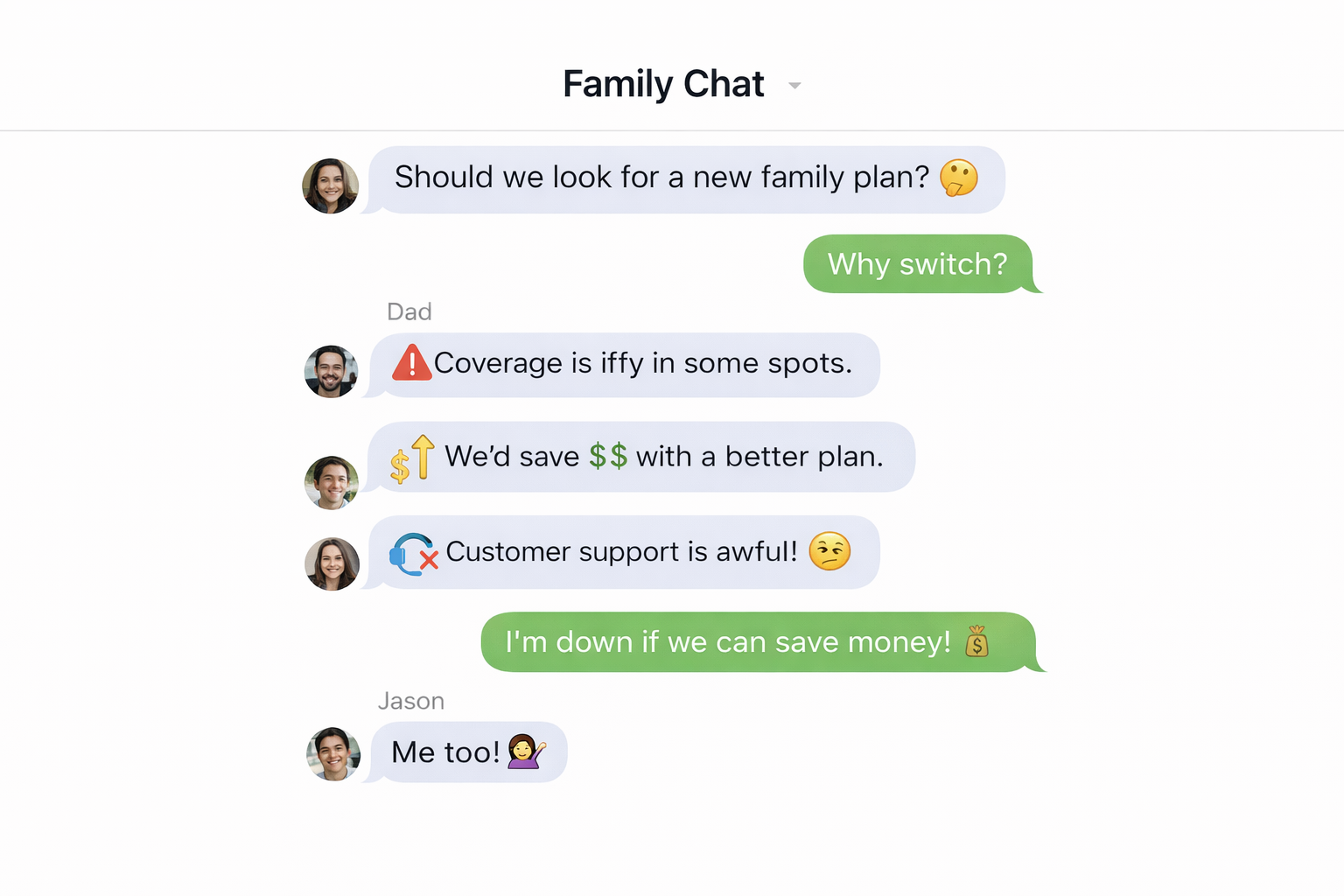
Key Takeaways
- Your biggest savings come from matching each family member’s plan to how they actually use data instead of putting everyone on unlimited by default.
- Family plans save the most money when they combine multi-line discounts with flexibility, so you are not paying for features or data your household does not need.
- No-contract plans protect your budget long-term by allowing you to adjust, downgrade, or switch as your family’s needs change without penalties.
Family phone plans sound simple in theory. Bundle a few lines, get a discount, call it a day. In reality? That’s how a lot of families end up paying for way more data, features, and “extras” than they actually need.
At RedPocket, we talk to families every day who want the same thing: reliable service, predictable bills, and real savings without locking themselves into something that stops making sense six months later. The good news is that choosing a smarter family plan isn’t complicated once you know what to look for.
This guide walks you through it step by step, focusing on what actually moves the needle on your monthly bill and what you can safely skip.
Assess Your Family’s Data and Usage Needs
Before you compare plans or prices, start with the most important question: How much data does each person actually use?
Check each family member’s phone settings or recent bill to see their average monthly data usage. This is the fastest way to spot patterns, like one parent who streams constantly, a teen who’s glued to Wi-Fi at school, or a younger child who barely uses mobile data at all.
This step alone can save families hundreds of dollars a year. Many households default to unlimited plans across the board, even when most lines rarely come close to using that much data. If some family members spend most of their time on at-home or school Wi-Fi, they may need far less mobile data than you think.
The goal here isn’t perfection. It’s clarity. Once you know who actually needs data and how much, you can stop paying for coverage that goes unused.
Research Available Family Phone Plan Options
Once you know your usage, it’s time to look at what’s out there. That means comparing both major carriers and MVNOs — mobile virtual network operators that lease coverage from big networks but often offer more affordable, flexible plans.
As you research, pay attention to how plans are structured. Some family plans force everyone onto the same data level, while others let you mix and match. That flexibility matters. A plan that lets parents keep higher data while kids stay capped is often far more cost-effective than one-size-fits-all unlimited bundles.
Coverage matters just as much as price. Use coverage maps and tools to confirm that the plan you’re considering works where your family actually lives, works, and travels. A cheaper plan isn’t a deal if the signal doesn’t hold up day-to-day.
At this stage, you’re not choosing but narrowing the field to plans that align with your family’s real needs.
Compare Costs, Discounts, and Features
This is where savings either happen or quietly disappear.
Family plans usually lower the per-line cost as you add more lines. These multi-line discounts can easily save families hundreds of dollars per year compared to separate individual plans. But it’s important to look past the headline price and focus on the total monthly bill.
Watch for plans that require unnecessary unlimited data or a minimum number of lines. These can look affordable on paper, but end up costing more for smaller families or households with mixed usage levels.
A quick definition that helps here: a multi-line discount is a price reduction applied when multiple phone lines are bundled together, lowering the average cost per line. It’s only a win if the underlying plan fits how each line is actually used.
The best family plans balance discounts with flexibility, so you’re not saving on paper while overspending in practice.
Consider Additional Perks and Benefits
Many family plans advertise extras like streaming subscriptions, hotspot data, or international calling. These perks can be valuable, but only if your family would pay for them anyway.
For example, a plan that includes free streaming can save money for families already subscribed to multiple services. For others, it’s just a higher monthly rate bundled with something they don’t use. The same goes for hotspot data and international calling; they’re great for some families, unnecessary for others.
The key is to compare the added cost of a premium plan with the standalone value of the perks included. If the math doesn’t work in your favor, it’s not really a perk. It’s padding. Smart savings come from paying for what your family actually uses, not what sounds nice in a comparison chart.
Opt for No-Contract and Flexible Plans
Families change. Kids get older, usage shifts, people move, and needs evolve. That’s why wflexibility matters just as much as price.
A no-contract plan doesn’t lock you into a long-term commitment. You can change, cancel, or adjust without paying penalties. This is especially helpful for families with teens heading to college, fluctuating line counts, or changing data needs throughout the year.
No-contract plans also make it easier to switch providers if coverage or pricing stops making sense. You’re never stuck paying for a setup that no longer fits your life. In the long run, flexibility is one of the most underrated money-saving features a family plan can offer.
The Long and Short of It
Choosing RedPocket for an affordable family plan can be a smart way to save money because it offers a flexible, affordable plan on major networks without the high price tags of traditional carriers.
With the ability to mix and match lines and switch networks when needed, using tools like CoverageGenius™, you can tailor service to each family member’s needs while keeping your overall monthly cost down.
Frequently Asked Questions
Is a family phone plan usually cheaper than individual lines?
Yes. Family plans are typically more affordable than separate individual lines, especially when multi-line discounts reduce the cost per person.
How do multi-line discounts work, and how much can I save?
Multi-line discounts lower the price of each line as more lines are added. Depending on the provider and number of lines, families can save hundreds of dollars per year.
Should we choose unlimited data or shared limited data to save more?
It depends on usage. Families with light or moderate data use often save more with limited or mix-and-match plans, while heavy users may benefit from unlimited options.
How can I monitor my family’s data use to avoid overpaying?
You can track individual data usage through phone settings or your carrier’s account dashboard and adjust plans as usage changes.
Sources:
View or change cellular data settings on iPhone | Apple Support
How to Save $500 on Your Cell Phone Plan | Consumer Reports
Everything You Need to Know About MVNOs and Prepaid Phone Plans | Wired